
Drawing of our 12 meter boat
Drawing of our 12 meter boat
We are about to being our last season aboard Viking. Here are paintings and drawings from recent voyages plus some from Italy
Music by Bobby Darin


This is a second version of this piece. The first belongs to Dones de Picanya.
From Saatach’s description
I have done many paintings and drawings inspired by musical performances. This second original acrylic painting on paper, “Not Just Another Pretty Face/ Mas Que Otra Cara Bonita”, is the latest in a series of music related work. The piano player takes center stage, rendered with both abstract and expressionist elements. The large painting is a study in contrasts: light and dark, color and tone, and a blend of artistic styles.
There’s a dynamic interplay between the abstract, realistic and expressionist. The figurative elements of the piano player are grounded in reality, while the surrounding abstract textures evoke the passionate atmosphere of a live musical performance.
This piece makes a dramatic statement, vibrant energy and thought-provoking composition.
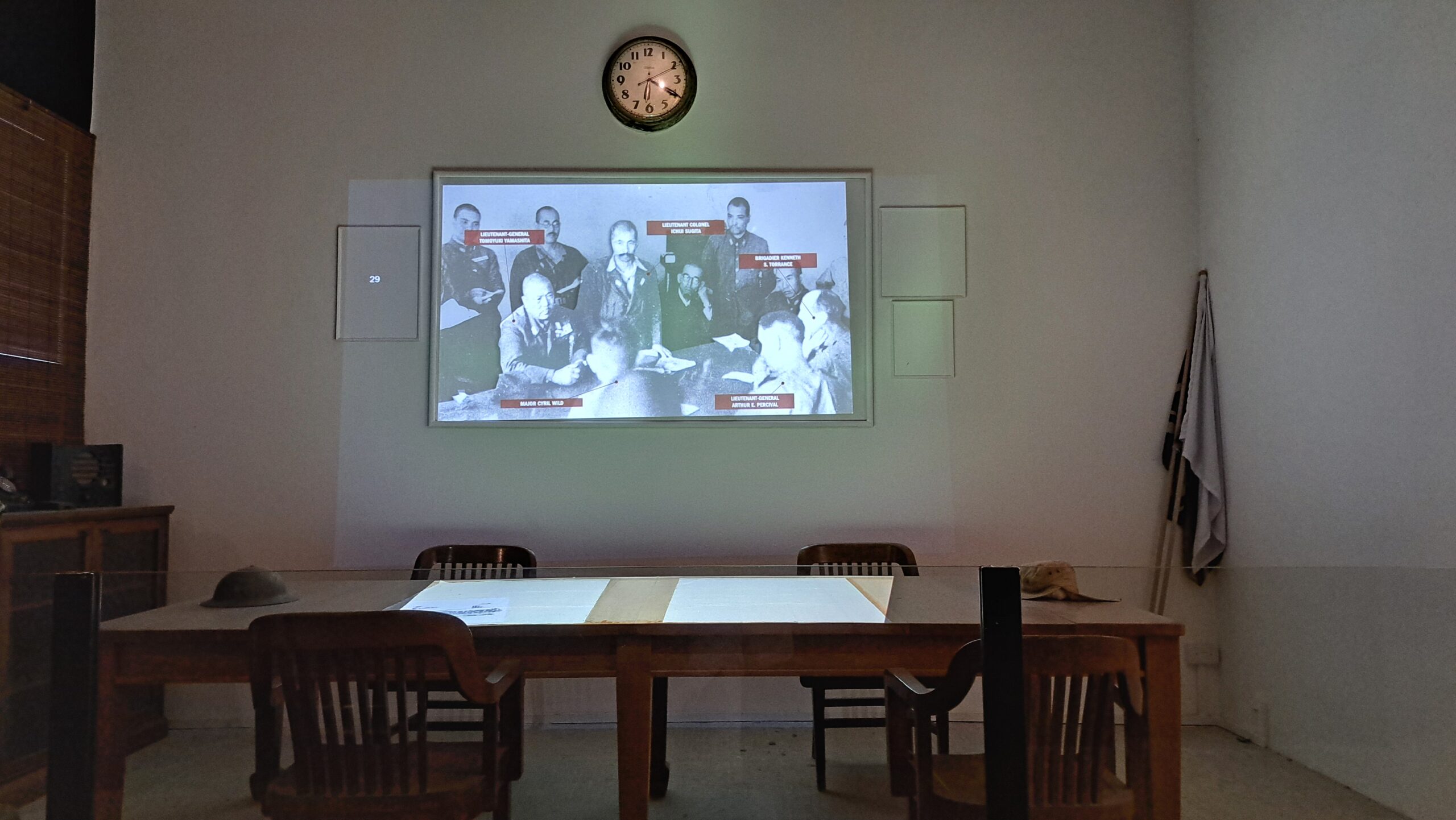
The Former Ford Factory is now a museum about Singapore during WWII. Built in 1941 as a state of the art facility, it was the first Ford production plant in SE Asia after 15 years building cars in garages. In this very building the British surrendered to the Japanese on February 13, 1942, the office they used left as it was.
The Brits should have invested more in the defense of Singapore during the 1920’s and 30’s, but given the distances and territory involved it simply did not have enough soldiers and equipment. It’s not that they did not try. In the early 1920’s the British began constructing a naval base, finishing in 1939. However it was too small, only able to support about 20% of the British fleet. The plan was for Singapore to hold out until the rest of the fleet arrived. The Japanese capture of Singapore took about 60 days. The British fleet still had not arrived.
Japan began bombing Singapore on December 8, 1941, hitting Chinatown and Raffles Place. They landed in Malaysia at the same time. After the 1937 Japanese attack on China many Singaporeans joined the Singapore Volunteers Corps and the Royal Navy Volunteer Reserve, others the Civilian Defense Corps and the Medical Auxiliary Services. Some helped build air raid shelters. These efforts, like the British naval base, were of little use.
The experienced soldiers of the 5th and 18th divisions of the Japanese armies led the ground assault. Within a day they destroyed or damaged more than half of British largely obsolete aircraft and captured airfields in Malaysia. They belatedly formed eight civilian battalions of 150 people each to build defensive fortifications and others, with just ten days of training, were assigned to defend Jurong Road. Fighting in Singapore itself, which began in early February, 1942, lasted less than a week.

British Surrender
On 13 February 1942, Japan captured the Ford factory. On 15 February 1942, Lieutenant-General A. E. Percival unconditionally surrendered in the boardroom, determining the fate of Singapore for the next three and a half years. https://corporate.nas.gov.sg/former-ford-factory/overview/.


Japanese Rule
There were some 100,000 POW’s and several thousand European citizens at the time of the Japanese takeover. About 3000 were marched to Changi Prison and the nearby barracks, designed to hold 800. Civilians passed them food and money along the way, despite the risks. Once imprisoned they were always hungry, yet made to clear war damage, bury corpses and build memorials to Japanese dead.
The Japanese massacred thousands of Chinese in February and March of 1942. There were other random acts of violence and intimidation. By 1943 the violence had abated, but there were still arbitrary arrests and torture. Food, fuel and medicine were in short supply in a city of one million with few natural resources. Many survived on what they were able to grow. Starting in September, 1942 many were sent to work on the Siam-Burma Railway. Huge numbers died under the horrific working conditions. Approximately 17,000 were housed in barracks designed for 800.
Japan’s government renamed Singapore to Syonan-to (Light of the the South), changed the clocks to Japanese time and the calendar to their own. They took over the businesses of all Western companies and some Chinese as well. Businesses were made to produce goods for the Japanese war effort. There was strict rationing and movement was restricted. There was high official unemployment but there were illegal jobs, black markets and a large number of off the books street vendors.
To reduce overcrowding the Japanese opened farmland, hoping to relocate 300,000 Singapore in Endau, Johor, Malaysia. Some 12,000 Chinese were the first to be sent, successfully establishing farms. The second effort was not successful as the land was not suited for farming, while thousands died from malaria. The effort ceased after that.
In resistance, Malaysia Communist Chinese formed the Malayan People’s Anti-Japanese Army. Those aligned with the Kuomintang joined Force 136. Allied forces engaged in sabotage, sinking seven Japanese vessels in the Singapore harbor. There were 11 US air raids, ending in March, 1945.
Post War Singapore
The Japanese forces of Singapore and Jahore surrendered aboard HMS Sussex. The British returned in September, 1945, welcomed by the locals. There was much need for welfare and relief. The Allied Land Forces – South East Asia tried only 131 men for war crimes. Only two were sentenced to death. The Singapore Chinese Appeal Committee unsuccessfully asked for additional death penalties.
On April 1, 1946 civilian administration resumed as a Crown Colony. As in Brittan, the government became involved in education, housing, health and social welfare. While the British introduced self-government in Malaysia it did not do so in Singapore. Communist insurrections in China, Malay, Burma, Indochina and the Philippines were a major concern, with Singapore serving as a base for defending against Communist expansion. Malaysia became firmly anti-communist in the 1950’s. As a result Singapore became part of Malaysia on 16 September 1963 following a merger with Malaya, North Borneo, and Sarawak.
Singapore became an independent republic on 9 August 1965 after its expulsion from Malaysia. It has evolved into not only a major port with its modern facilities but also a major finance center after a difficult period following independence.

Adding to the long series of watercolor paintings from my travels, Rural Singapore is the first from that trip. The large leaves, variety of colors vegetation, some which is not quite like what I have seen before, yield a strong impression of lushness befitting a warm and humid climate. The abstract elements provide diversity. We are doing more than just giving you what a photo could, another level of variety in form and color with which to feast the eye.
To purchase, go to https://www.saatchiart.com/art/Painting-Singapore-Rural/664581/13685391/view

Continuing with my efforts in charcoal, this is a winter scene in the Netherlands.
We’ve traveled extensively on the canals of the Netherlands. Not long ago these canals froze every winter and to this day the Dutch people are over-represented in the Winter Olympic speed skating events.
This canal is located near ‘s-Hertogenbosch. People call it Den Bosch. There are some 160,000 residents. It is the capital of the province of North Brabant and its fourth largest city by population in the Netherlands. It is famous for the Bossche bol – called chocoladebol locally. It is a puff pastry filled with delicious thick whipped cream and covered with chocolate.

For sale at https://www.saatchiart.com/art/Painting-Looking-Out/664581/13637737/view
Another in my series of Hopper inspired paintings, a woman looks out over a golden field with a thick green forest at its edge. Figures walk in a line towards the dark woods, phantoms in the foreground. Completed in 2021, modified 2025.
From Saatachi’s description: https://www.saatchiart.com/art/Painting-Looking-Out/664581/13637737/view
“Looking Out” is an original acrylic painting on canvas, inspired by the iconic style of Edward Hopper. The expressionistic landscape depicts a woman gazing out over a golden field that meets a thick, verdant forest. The scene takes on a symbolic and mysterious quality with the addition of fantasy figures walking towards the dark woods.
The artist’s use of colorful greens, blues, and yellows creates a vibrant and captivating image. The painting’s technique and materials enhance the overall expressionistic effect, inviting viewers to explore the narrative and emotions within the piece.
Occupying a unique position on ocean trading routes enhanced by its importance to the British Empire, with Malaysia and Thailand to the north, Indonesia to the east and China to northeast, India to the northwest, Singapore developed a rich, diverse Asian cuisine. The result is a potpourri of spices and ingredients, bewildering to most Western visitors.
Hawkers
You can try an astounding variety of dishes at Singapore’s hawkers, vendors of its famous street food housed under open air roofs. Most stalls have a number of offerings, ranging from fried shrimp breads to complex rice dishes. It’s hard to know what you are ordering even though the signs are in English. If you have a knowledgeable friend to join you it’s all the better, which was the case for me.
You sit comfortably while dining on most days as fans keep the air moving. Thus well ventilated, the shaded space immerses you in aromas galore.

There is no table service. If that’s what you want choose a restaurant, though you will loose the extensive range of options you will find among the hawkers and you will usually pay much more. Both restaurants and hawkers follow modern hygiene practices so there is no advantage to restaurants in that regard. Hawkers are by far more popular choice of locals, especially for those who especially enjoy or need the budget prices and are willing to bus their own table- you must or you could be fined!
In the course of 11 days I sampled a couple of dozen dishes. Here’s a short slideshow video of what came my way:
Culinary influences include Chinese from multiple provinces including Peranakan (southern China), Malaysian, Indonesian, Indian both north and south, and Western traditions including the ubiquitous hamburger, English and the Portuguese-influenced Eurasian, known as Kristang).
The dishes often have a bit of hot spice, with extra on the side. The cuisine in general carries a bit of sweetness, often barely subtle enough for my taste. The Indian dishes include both northern and southern versions, a bit lighter on the hot pepper than you might expect. The Korean restaurant we visited offered meats cooked on the table mounted grills. The sides were for me disappointingly mild, adjusted to the local taste I suppose.
Singapore’s offerings include Chinese hotpots. You can order wheat noodles served in a soy or miso sauce. You can add sliced pork (chāshū), nori (dried seaweed), bamboo shoots (menma), narutomaki, and scallions.
Nearly every region in Japan has its own variation of ramen. One Japanese ramen we went to had bland offerings. Another ramen joint, Enishi is a tiny place with just 12 stools at the bar, cooks and workers flying about. They have ramen dishes more to my liking. This is not a sit and relax kind of place. A sign says that in busy times you may only be allowed 30 minutes. There was a line when we were dining, so I do not think we had even that long. Fortunately the ramen soup is served immediately.
Nearing the end of my visit my kind hosts asked me what I would like to have for dinner. I said I thought I was missing only the Chinese. None of the places we frequented I’d identified as such. He explained that labeling a eatery ‘Chinese’ here would be like labeling a restaurant as Spanish when in Spain. So I had been served Chinese meals that I did not recognize as such. That’s how little I knew about the scene in Singapore. At least I learned more about how vastly Chinese cuisine varies by province. In the west we get mostly Cantonese and Sichuan offerings.
Eggs galore
I’ve never seen so many dishes that come with an egg. Many are fried and laid on top, others hard boiled. The trendy breakfast is toast with a slice of butter with a soft boiled egg on the side.

The breakfast includes the local coffee called Kopi. It has its roots in Malaysia . It is made from Robusta beans, the least desirable coffee bean, versus shade grown Arabica, then roasted in (eh gad!) margarine and sugar and then strained. They add evaporated and condensed milk. Somehow I managed to avoid it, but if you like it please let me know and tell how that’s even possible. I did not care to give it a go myself.
Desserts
Aside from fruit you can order desserts that from my point of view are quite strange. I can only report on two. You can see my reaction to cendol. It’s a dessert made with green rice flour jelly, coconut milk, and palm sugar syrup. Here there are also red beans. It’s called “dawet” in Java and “lot chong” in Thailand. Despite my initial reactions to red beans in a dessert, they offered an interesting contrast to the crunchy sweetness of the rest. Mango sticky rice was pretty good too, although I am not fond of sticky rice, just because it’s so gummy.


Wikipedia has an extensive article on Singapore’s cuisine. Check it out at https://en.wikipedia.org/wiki/Singaporean_cuisine

This drawing began its life as an Italian actress, first as a painting and then appearance modified here as charcoal drawing. This yields a high contrast that leaps from your wall. The foreshortening is extreme. Highlights in the hair pop off the paper.
To purchase go to https://www.saatchiart.com/art/Drawing-Woman-in-Black-and-White/664581/13608525/view